
Smoking Bans Spread - The Golomb Effect
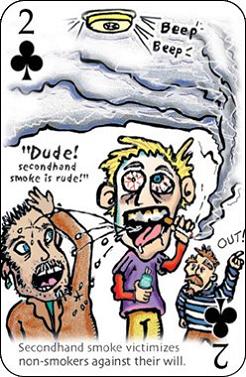
A study has shown that in New Jersey (which has yet to start the ban), bars and restaurants had more than nine times the levels of indoor air pollution compared with those in neighboring New York City, which had banned smoking in those establishments (1).
In the northeast, Connecticut, Delaware, Maine, Massachusetts and New York have all implemented a comprehensive statewide ban on smoking in indoor workplaces. Basically smoking bans are spreading like, well, cancer.
It was only a matter of time before New Jersey also joined the ban-wagon [that's my word]. People in New Jersey who worked or dined in New York would notice how much more pleasant it was to work or eat or hop bars where the air was not intolerable and wanted, then demanded the same.
I'm certain that it will happen in Pennsylvania and quickly throughout the whole country. When you are constantly surrounded by a putrid, foul, stinky, unhealthy fog of cigarette smoke you tolerate it because you do not know any better.
Exposure to venues in nearby states makes one notice how much better it is and fuels the push to have their own states clean up their act.
I call this the Golomb Effect. One can live in crap up to one's neck and not realize that one doesn't have to live that way until you go to a neighboring locale and see the light [but not through a haze].
To businesses who worry that a smoking ban will adversely affect them, let me mention this, "According to the 2004 Zagat New York City Restaurant Survey, which polled nearly 30,000 New York restaurant-goers, “the city’s recent smoking ban, far from curbing restaurant traffic, has given it a major lift. In fact, the survey reports that by a margin of almost 6-1, respondents said they are eating out more often because of the city’s smoke-free workplace policy.“
We see the Golomb Effect in Canada where province after province is enacting territory-wide bans. Not long after Ireland went smoke-free, the UK began the process and will be smoke-free shortly. Scotland will start their ban this spring. The entire EU should be smoke-free within a few years.
There are some who would call us "Health Nazis". I suppose an equally valid appellation could be applied for those who want to keep young children out of the sex trade as "Kiddie Porn Nazis". Here's a headline for you: appending the word Nazi to a virtuous and laudable activity does not render it evil. Hurl your slurs at somebody who cares.
There's an email going around that "The American tobacco industry reports that it provides jobs for 57,000 Americans - not including physicians, X-ray technicians, nurses, hospital employees, fire-fighters, dry cleaners, respiratory specialists, pharmacists, morticians, and gravediggers." This happens to be one of the few chain-emails that isn't a hoax.
By the way, I smoked from the time I was 9 years old until I was 32. I quit 28 years ago.
ENDNOTES
(1):
Univ of Med & Den of NJ, Study Finds That New Jersey Bars and Restaurants Have Nine Times More Air Pollution than Those in Smoke-Free New York
Are you planning your holiday party at a venue with dangerous levels of carcinogens and other pollutants in the air? If you are celebrating the holiday season at a bar or restaurant in New Jersey, the answer is probably yes.
A new study out today (December 14) indicates that bars and restaurants in New Jersey have more than nine times the levels of indoor air pollution compared with those in neighboring New York City, which does not allow smoking indoors.
The results of the study, conducted by researchers at Roswell Park Cancer Institute in Buffalo, N.Y., showed that patrons and workers in bars and restaurants in New Jersey were exposed to more than nine times the level of pollutants than those in New York City.“These results indicate that it’s not just about having your clothes smell badly after a night out, but that the environment in these bars and restaurants is really unhealthy,” said Jonathan Foulds Ph.D., Director of the Tobacco Dependence Program at the University of Medicine and Dentistry of New Jersey (UMDNJ)-School of Public Health. “In fact, for people who work in these polluted environments on a daily basis, it could mean the difference between whether or not they contract a serious disease.”

