
Muslim Women are Delusional
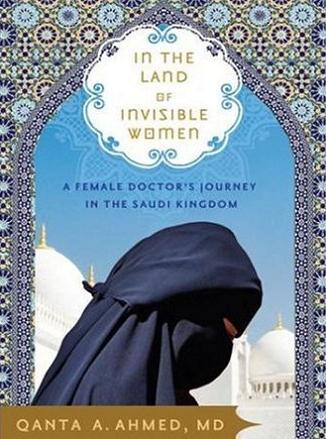
There is no hope for Muslim women when even their brightest delude themselves about their religion. When we read the following story about Dr. Qanta Ahmed, an assistant professor at the Medical University of South Carolina, and her decision to practice medicine in Saudi Arabia, we are informed that she readily admits that women - even doctors - are invisible in that country and indeed she had some misgivings about going there at all.
So at first, it seems we have a Muslim woman not blinded to the realities of how they are treated under Islam. In her memoir of her experiences there, In the Land of Invisible Women: A Female Doctor's Journey in the Saudi Kingdom, she hoped that a book written by a Muslim who grew up in the West can, in some small way, bridge the divide of understanding between the Middle East and Western culture.
The good doctor reminds me of mothers of assorted uncivilized savages who, when confronted by news that their children committed some horrible crime, utter the following oft-heard refrain: "He's really a good boy!"
Muslims like Dr. Ahmed have invested their entire lives in their religion and because they themselves are decent, hard-working, non-violent, intelligent people they cannot see Islam for the savage, primitive, violent, intolerant, oppressive, cruel, ruthless, and brutal political system it really is.
Take this quote from Dr. Ahmed,
Center for Islamic Pluralism, 18 Auf 2008, Women doctor shares journey into heart of Islam
"One of the central errors westerners are constantly assaulted with is the use of this term jihad," she says in an interview at her condominium overlooking Charleston's peaceful Ashley River. "The central jihad for all of us is to constantly improve and be the best we can be and try to adhere to some very pure ideals."
She also hopes it might help dispel what she says is a misconception that Islam advocates violence.
"This is absolutely heinous and false," she says. "Islam values life above anything. We are taught in the Qur'an that man's right to life exceeds even God's rights on man."
If, in the Qur'an, man's right to life exceeds even God's rights on man, then why is it that in every Islamic country blasphemy or apostasy is punishable by death? Are intelligent, educated Muslims so delusional that they can repeat so obvious a lie that a man's life is more precious than a slur against Islam? How is the right to life sacred when a human being can have it taken, under the full force of law, because of mere words?
I doubt Muslims ever repeat the singsong, "Sticks and stones may break my bones, but words can never hurt me."
Here's a quick blurb of her book:
Publisher's Weekly, Nonfiction Reviews: Week of 6/2/2008
This memoir is a journey into a complex world readers will find fascinating and at times repugnant. After being denied a visa to remain in the U.S., British-born Ahmed, a Muslim woman of Pakistani origin, takes advantage of an opportunity, before 9/11, to practice medicine in Saudi Arabia. She discovers her new environment is defined by schizophrenic contrasts that create an “absurd clamorous clash of modern and medieval.... It never became less arresting to behold.” Ahmed’s introduction to her new environment is shocking. Her first patient is an elderly Bedouin woman. Though naked on the operating table, she still is required by custom to have her face concealed with a veil under which numerous hoses snake their way to hissing machines. Everyday life is laced with bizarre situations created by the rabid puritanical orthodoxy that among other requirements forbids women to wear seat belts because it results in their breasts being more defined, and oppresses Saudi men as much as women by its archaic rules. At times the narrative is burdened with Ahmed’s descriptions of the physical characteristics of individuals and the luxurious adornments of their homes but this minor flaw is easily overlooked in exchange for the intimate introduction to a world most readers will never know.

