
A Googleplex of Earths
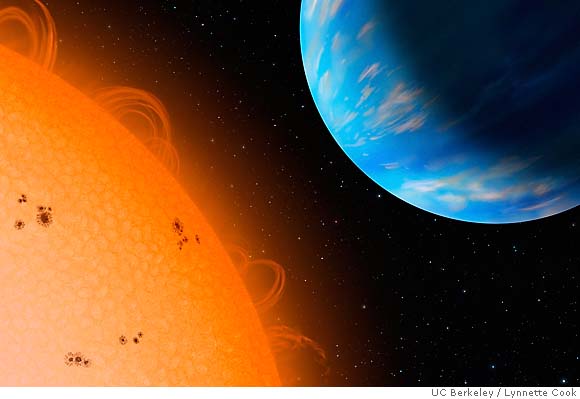
exoplanet GJ436b (right) orbiting M dwarf
star, Gliese 436
Photo Credit: SFGate
I believe that most travelers from small American cities when asked where they hail from reply with the name of the nearest large city or simply mention the name of their state. For example, very few people even here in the America know of Bayonne, New Jersey so usually when asked where I come from I answer with either New York City or New Jersey, depending on my mood.
I was 20 years old in the fall of 1965 eating dinner in a small restaurant on Rehov Yehoshua Bin-Nun (Joshua Son-of-Nun Street) in Jerusalem, Israel, when a waitress noticed I was reading an English newspaper, so she asked where I was from; I told her New Jersey. Not being familiar with all the cities and states in America, she answered back, "Oh, New Jersey, I have heard of that city."
I didn't have the heart to tell her that the "city" of New Jersey though one of the smallest in the US was larger than the entire state of Israel (8,729 mi² vs 8,522 mi²) and even had a grossly larger population (6.6 million vs 2.6 million) [Source: US Census].
But this is what happens when people have very little knowledge of scale. I recalled this incident from my past when I heard some young people discussing the possibility of life on other planets. It really is a silly thing to discuss when one realizes how many planets there are just in our galaxy alone (tens of billions) and how many galaxies (hundreds of billions) there are in our observable universe (all we can ever see) and how many universes there are in all of existence (at least a billion trillion (1) - and some say an infinite number).
Assuming that single-cell life can occur once in a trillion trillion trillion (1 out of 1,000,000,000,000,000,000,000,000,000,000,000,000) planets suitable for life (carbon, oxygen, water, right range of temperature) and that intelligent life can evolve once in a trillion trillion trillion of those planets then I calculate that at the lower end there are at least a googleplex (10 to the googolth power) of planets with intelligent life on them. Those with a true perspective of how vast existence really is, know that there are easily at least a billion planets out there which have a country which is ruled by a president with the exact name Barack Obama. On some planets he is a liberal, on some a conservative; on some his middle name is Hussein, on some it is George W.; on some he is white, on some he is black; on some he is Christian, on some (like our planet) he is Muslim; such are the vagaries of chance multiplied by infinity.
"But," the less-informed waitress may ask, "if there are so many gazillions of planets with intelligent life, why haven't they contacted us?" Simple, it is only in the past century that we have reached the level of technology to send signals into space or receive them. But any radio signals to an inhabited planet just within our own galaxy could easily take tens of thousands of years to reach and an equal number of years to return in response. We are too early in our existence and even so, most of the universe is so far away from us that signals from other planets even those sent billions of years ago have yet to reach us.
I am sure that in a few hundred million years from now we will have contacted life on other planets. But the exchange will probably go like this:
Sent on 5 Jul 105034045 A.D. from Planet Zayon: "Hello life-form on planet ^#3$6@667*23 - we are from planet *#@@@!66342@ but you can call us Zayon."
Above message received on Earth on 3 Mar 354121576 A.D.
Earth responds on same day: "Hi life-form on Zayon - we are Earth. How are you?"
Although the message from Zayon took 249 million years to reach us, our message back to them will take tens of millions of years longer to reach them because the universe is expanding and even longer for them to reply to us. Sometime in the year 1 billion plus A.D. we'll get this from Zayon: "Fine - and how are you?"
And that, my dear waitress, that is only a twinkling of an inkling of a smidgen of a sliver of a hint of how big the universe really is.
ENDNOTES
(1):
Science and Religion Today, How Many Universes Exist?
If multiple universes do exist, the person who has shown them likely to be without number or end is physicist Andrei Linde, originally from Russia, now at Stanford University. In the early days of proposing inflation theory (the early 1980s), Linde showed how inflation could be expanding “chaotically and eternally.” In some models, inflation must be expanding chaotically and eternally.
The entire ensemble of perhaps infinite regions of disconnected space-time, these innumerable pocket universes, has been affixed with a new term—“multiverse.” Linde says that each of these extremely large regions within the multiverse may have different laws of physics. But since we live in one of these “universes” and because it is so large, we can only make measurements in our one universe—the others are too far away for us to ever receive any information—so all these laws seem unchanging and immutable.
Linde portrays “universes” as painted balloons on canvas. Each of his balloons is a separate universe, each with different laws of physics. The whole collection of universes, the multiverse, is incomprehensively vast. And growing ever more so.
Max Tegmark, a cosmologist at MIT, goes further still, seeing real possibilities for generating multiple universes through quantum parallel universes, where, with every tick of time (whether Planck time at 10-44 seconds or every observational instant), the universe branches into different realities. Tegmark says that “one of the most beautiful ideas in all of science is that the structure of the universe on a large scale actually originates from the microscopic quantum world” and that multiple universes by quantum branching would take this idea to its ultimate conclusion. Not yet satisfied, he conceives that multiple universes may also be generated by any coherent system of mathematics.

