
Rulers of Islamic Countries Fear Unrestrained Islam

No one knows the evil power of Islam as well as the governments in secular Muslim nations. Sadly, most Americans and Europeans mistakenly assume Islam is a religion. Leaders in Muslim countries know better - they know Islam is a political and military system bent on world domination.
For example: Egypt, a country where Islam is the state religion and 90% of her inhabitants are Muslim, severely represses Islamic political parties because they understand that those parties would destabilize the country by instituting Shariah law and dismantling everything modern (or western) in the country (1), perhaps even destroying all traces of the ancient Egyptian culture as devout Muslims have done in the past to the native artifacts of the cultures they conquered.
While western countries struggle with the morality of banning the hijab, secular Muslim-majority countries have no such qualms; as I pointed out in my article If Muslim Countries Can Ban the Veil Why Can`t Infidels?:
Egypt, 90% Muslim, was smart enough to ban the niqab in schools as being backward and demeaning to women. Turkey, 99.8% Muslim, and Indonesia, the largest Muslim country in the world, ban the wearing of the veil in their public schools.
Egypt, Turkey, Pakistan, Indonesia, Syria and others who suppress Islamic parties know that wearing the veil is the first sign that devout Muslims are gearing up to take over the country.
So consider the photo at the top of this article.
Now consider the photo below:
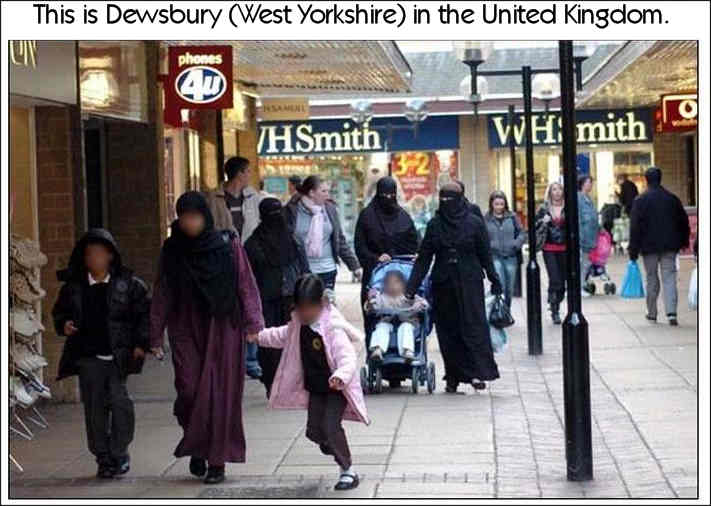
Only western governments are stupid enough to actually facilitate the Islamization of their culture and country.
ENDNOTES
(1):
Federal Research Division of the US Library of Congress, Egypt - The Rise of Political Islam and Repression
The more violent messianic groups, such as Al Jihad, were the targets of continual repression and containment, apparently only partly successful. Their destabilizing potential was indicated by their role in the assassination of Sadat, a major rebellion they mounted in Asyut at that time, a 1986 wave of attacks on video shops and Westernized boutiques, and assassination attempts against high officials. The regime responded by arresting thousands of these radical activists. Another Islamic group, the Jamaat al Islamiyah, recovered the control of the student unions Sadat tried to break. In the mid-1980s, they won twice the number of votes of the NDP in student union elections, and the secular opposition was squeezed out. The left made inroads in their dominance toward the end of the decade, however. Radical groups belonging to Jamaat al Islamiyah tried to impose a puritanical, sometimes anti-Coptic, Islamic regime on the campuses and in the towns of Upper Egypt, where local government sometimes bowed to their demands. More moderate groups in Jamaat al Islamiyah could turn out large disciplined crowds for public prayer, the nearest thing to a mass demonstration that the regime reluctantly permitted. A major contest was waged over Egypt's 40,000 mosques; the government sought to appoint imams but had too few reliable candidates, while the movement sought to wrest control of these major potential centers of Islamic propaganda.

