
Donating Organs Should be Presumed upon Your Death
Take the following hypothetical situation. Harry X., a legal resident of New Jersey with ten million dollars in liquid assets died last year when, fortunately for his family, there was no Federal Estate Tax.
Let us also assume that Harry died without leaving a will. The ten million bucks would be distributed as follows: his wife Amy would receive the entire amount and his two boys, Tom and Dick, would receive nada, zip, nothing.
Now here is where it gets tricky: if his wife has at least one living grand-child from a previous marriage or if she is not the mother of Harry's children, then she would receive only $5,100,000.00 and each of his two boys would get $2,450,000.00.
Here is the reasoning of the state: if Harry's wife has a child from a previous marriage and that child has a child, it is the experience of the court that step-children sometimes get more of an inheritance than the natural children of the deceased (The Cinderella syndrome). To protect the natural children, the court distributes what it deems a fair amount to each surviving child.
Each state in the union has its own formula for determining intestate succession. You may ask, "Is this fair?" Is it right that the state uses a default formula for what happens to your property if you didn't care enough to draw up a will to designate your preferences? I say yes, of course it is fair and right. If you didn't care enough what happens to your property to put it in writing, then the state should decide who gets your stuff according to law. Otherwise left to bickering survivors, we would have chaos and unfairness and as we hear so often, violence and even murder.
In the same manner, I believe that unless you specify in writing how to dispose of your organs after your death, it should be presumed that you intended for the hospital to distribute your organs, just as it is presumed you intended for the state to distribute your estate in the absence of written instructions.
Imagine for a moment that the law of intestate succession worked the same way as the present organ donor system: that since you did not declare your intentions in writing, your entire estate is to be buried or cremated with you. Would we not call such a system utterly insane, unfair, and ridiculous?
Likewise, it is the height of insanity to presume that in the absence of a written document, that a person would want to take to the grave his organs and body parts (now completely useless to him) that could save the lives of others. Unless someone really objects in writing noting that they are selfish, insensitive, nasty pieces of crap and they want to take it with them, why can't the default distribution be the same as for property left after death?
For Jews Organ Donation May be Mandatory
Now, now - before any of my devout Jewish readers get into a snit, I know some of you consider a donation of a live organ to be forbidden. However in my opinion you are pious fools. But not all religious Jews are idiots - let me say, for those who do not know, that some rabbinic authorities believe that organ donation may be mandatory, and rightly so.
But let's consider what Jewish law says. There is the case of nivul hamet, which forbids the needless mutilation of a dead body. However an autopsy may be performed if an epidemic is raging and there is need to determine its cause. And obviously where foul play is suspected, an autopsy must be allowed to help police determine cause of death and as an aid in their investigation. And if there are people waiting for particular organs, the "mutilation" certainly is not needless.
In the case of halanat hamet, which forbids delaying the burial of a body, it is common practice to delay the burial "for the honor of the deceased," that is, to allow more time for far-flung family to come to the funeral. If the Law allows delay for convenience of the living, then certainly the Law should allow delay to save a life through organ donation. Doing a mitzvah (good deed) trumps minhag (custom).
Then there is hana'at hamet, which forbids getting benefit from a dead body. OK, no one should make money by selling a dead Jew, I get it. However, the Earth eventually benefits from a dead body after its decomposition and return to dust. If life is sacred, why shouldn't someone's life benefit from a dead body?
And finally, here is what makes Judaism a compassionate and humane religion: Jewish law can be broken to save a human life. One can do work on the Sabbath, eat pork, shave one's beard, jump into a lake naked, whatever, if it will save a human life. Those who will not follow this rule, those who would follow custom rather than do right, they are destroyers of the world.
Notwithstanding the above, if one puts in writing that they do not want to donate their organs, then fine, they can be pious idiots responsible for the needless death of someone they could have saved. OK fine, let them meet their maker with their soul stained.
To be clear: I am only concerned here with those who do not put in writing that they do NOT want to donate their organs.
Christian Organ Donation and the Golden Rule
Now I would like to address my Christian readers.
If some tragic event threatens to cut it short wouldn't you want your life saved with an organ transplant? Isn't the Christian thing to do, to do onto others as you would have them do unto you? If you would want someone to save your life with an organ transplant, isn't donating your organs the humane, decent, righteous, Christian thing to do?
It has been reported that up to 15 lives can be saved by one person. According to the United Network for Organ Sharing as of 14 Aug 2009, there are over 111,000 organ requests on the waiting list. If the default action upon death (without instructions otherwise) were donation, there would be no waiting list, ever. There would be no illegal trafficking in organs, there would be no illegal harvesting of organs.
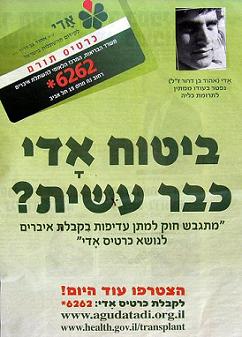
The SOP should be that a person is automatically an organ donor unless he specifies to the contrary with a medical bracelet alerting authorities that he is a selfish, insensitive person and wants his body to rot or burn rather than help another human being.
If someone believes his religion is against donating organs then his wishes should be respected, although I do not understand that kind of religion. A person of faith has to believe that God's design for our bodies is exactly the same as He has for the rest of His Creation. This year's leaves are mulch for next year's forest growth. Even though I am an atheist, I believe my body is sacred but I also believe I am merely a temporary custodian until the next soul needs it. If I did believe in God, it would be a Compassionate, Merciful Being who would instruct the faithful to return their leased bodies back into the pool when He has finally called their Soul to Heaven. But that's just me.
We can be organ donors or we can let our deaths be useless, stinking, rotting roadkill.

