It`s Official - We Are in Global Cooling
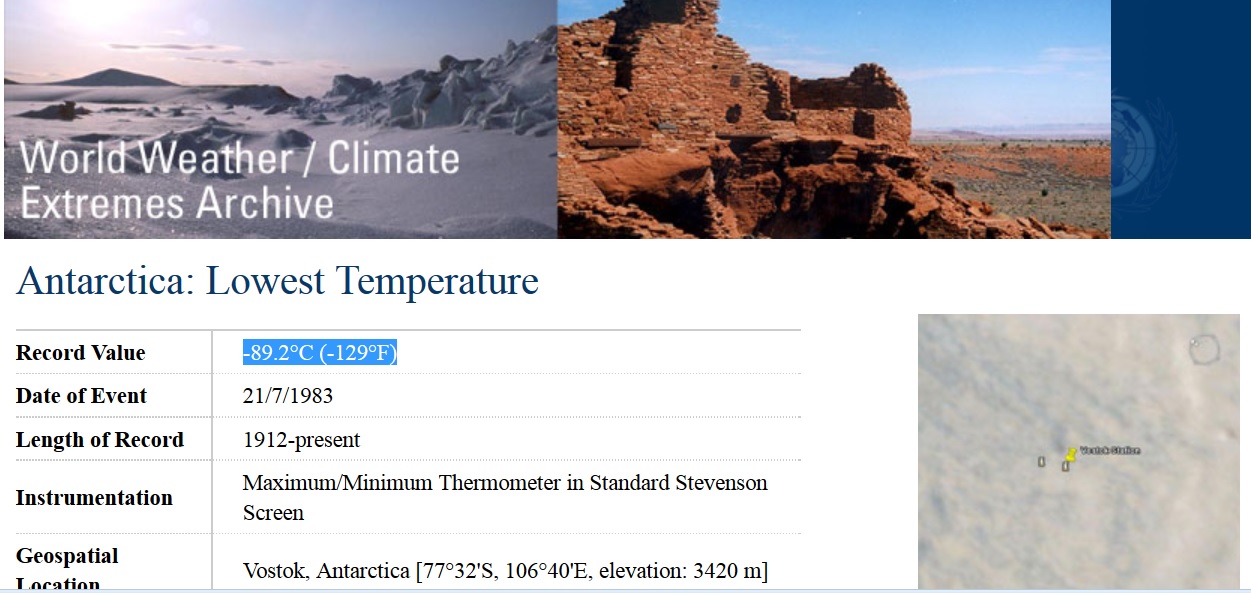
If you go to the website of the School of Geographical Sciences, at Arizona State University you will find the World Meteorological Organization's archive of our planet's climate extremes archive. There you will find that in 1983 Antarctica hit its lowest recorded temperature: 89.2°C (-129°F).
For some of my readers who may not know, Antarctica has 90 per cent of the Earth's ice and 80 per cent of its fresh water (1), and, according to NASA, there is more ice in Antarctica now than in decades (2).
This has baffled Global Warming Hoaxters who dismiss this amazing increase by claiming the ice may have spread wider but is thinner (3). Actually they're wrong, the ice is not only spreading wider than ever before, but it's thicker as well (4).
However, according to climate scientists such as Bill Maher, Global Warming cannot be denied and it has been getting warmer every year:
OK, Mr. Maher, recall that record cold of -129°F recorded in 1983 at the top of this article? According to you it should have gotten warmer these past 30 years, so perhaps you missed this report released today:
The Weather Channel, 9 Dec 2013, Antarctica Sets Cold Record of -135.8 Degrees
Feeling chilly? Here's cold comfort: You could be in East Antarctica which new data says set a record for soul-crushing cold.
Try 135.8 degrees Fahrenheit below zero; that's 93.2 degrees below zero Celsius, which sounds only slightly toastier. Better yet, don't try it. That's so cold scientists say it hurts to breathe.
A new look at NASA satellite data revealed that Earth set a new record for coldest temperature recorded. It happened in August 2010 when it hit -135.8 degrees. Then on July 31 of this year, it came close again: -135.3 degrees.
Is Bill Maher an idiot or what?
ENDNOTES
(1):
The Australian, 18 Apr 2009, Revealed: Antarctic ice growing, not shrinking
ICE is expanding in much of Antarctica, contrary to the widespread public belief that global warming is melting the continental ice cap.
...
Antarctica has 90 per cent of the Earth's ice and 80 per cent of its fresh water. Extensive melting of Antarctic ice sheets would be required to raise sea levels substantially, and ice is melting in parts of west Antarctica. The destabilisation of the Wilkins ice shelf generated international headlines this month.
...
Ice core drilling in the fast ice off Australia's Davis Station in East Antarctica by the Antarctic Climate and Ecosystems Co-Operative Research Centre shows that last year, the ice had a maximum thickness of 1.89m, its densest in 10 years. The average thickness of the ice at Davis since the 1950s is 1.67m.
A paper to be published soon by the British Antarctic Survey in the journal Geophysical Research Letters is expected to confirm that over the past 30 years, the area of sea ice around the continent has expanded.
(2):
Watts Up With That?, 22 Oct 2013, NASA Announces New Record Growth Of Antarctic Sea Ice Extent
Whenever the ice at the North and South Pole is mentioned, it is mostly in the context of melting ice triggered by global warming. However, the sea ice in Antarctica – in contrast to that in the Arctic – has proved to be remarkably robust. New measurements have now confirmed that. As the U.S. space agency NASA announced, the sea ice in the Antarctic has extended over an area of 19.47 million square meters at the end of September. That is the highest since measurements began in 1979.
(3):
NoTricksZone, 22 Oct 2013, Spiegel Surprised By “Amazingly Robust”, Record Antarctic Sea Ice – NASA’s Walt Meier Bewildered, Can Only Speculate
Spiegel, for the first time that I can recall, reports on how sea ice in Antarctica refuses to melt and has reached a new maximum record.
Antarctica’s record level sea ice is troubling those who were earlier convinced of the global warming science. Slowly, reluctantly, they are beginning to realize that something is wrong with the science. …
...
One scientist who is scrambling and who is visibly baffled is meteorologist Walt Meier, who seems irritated by the new puzzling Antarctic sea ice record - the second in 2 years. In the Spiegel report, he attempts to play it all down by claiming that the record amount is “only 3.6% over the 1981-2010 mean“. Meier adds: “This year the edge of the ice extends out only 35 kilometers further than an average year.”
Walt Meier is on the defensive, and insists the Antarctic ice sheet is getting thinner- especially West Antarctica. Spiegel adds that scientists are baffled by the sea ice increase, writing that it’s “a riddle“.
(4):
Ice Age Now, 26 Oct 2013, Antarctic sea ice may have reached both record extent AND volume!
Over the last months, Germany‘s Alfred Wegener Institute has conducted two winter experiments with the Polarstern research ice breaker in the Weddell Sea. In these expeditions the scientists encountered “ever thicker and more compact ice” (emphasis added), which supports the claim of maximum ice mass.
“… Even if there are no large area long-term measurements of sea ice thickness in the Antarctic, we conclude from various studies that the total volume of the Antarctic sea ice has grown over the last years….”